Loading... Please wait...For all your 5S requirements
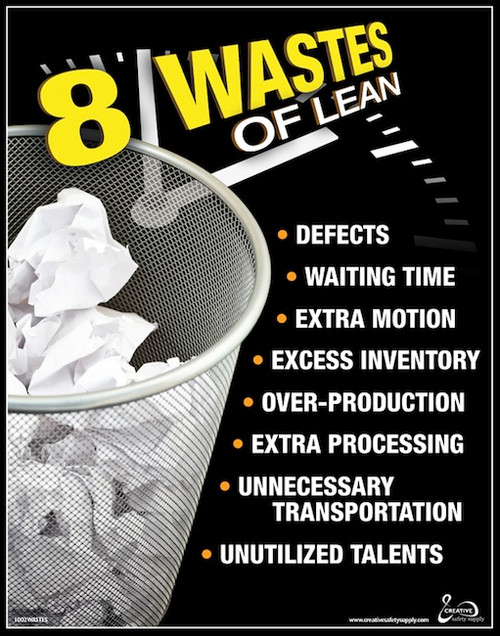
8 Wastes of Lean (Black) Poster 22"x28" high quality poster.
Use this poster to communicate the message of not wasting Time, Energy, Material, and Talents to all personnel.
The 8 Wastes of LEAN...
Learn them and you will find yourself and your company working more efficiently to raising your bottom line.
Lean thinking
Lean thinking is a term often used synonymously with lean manufacturing. Essentially, it is an encompassing phrase which involves the process of eliminating waste in the forms of time, space, materials, effort, and money. This waste, in turn, is replaced by better quality, happier customers, motivated employees, and more profit for your business.
The key of lean thinking is to eliminate waste. This is done by examining what produces positive results and then discarding whatever hinders or otherwise does nothing to help the overall goal. Traditionally, there are seven points which lean thinking points out as main areas waste is often occurring. These points make the acronym TIM WOOD, to make it easy to remember. They are transport, inventory, motion, waiting, overproduction, over processing, and defects.
Transport waste involves taking the time to move items (whether over a short or long distance) which do not need to be in order to complete a job. Inventory waste is items used which really were not needed at all, even down to the end results which was never used. Motion waste is both machines and people moving needlessly, which ends up in needless time lost and energy used which could be applied to other areas. Waiting waste is simply no activity during a period of down time while employees wait for the next project to come along. Overproduction waste is creating too many products before they are needed and then having to use up space to store them. Over processing waste is working too much on a project because of a poor supplied which have to be used. Finally, defect waste is using up effort in fixing problems which could have been otherwise avoided.
The lean thinking process can be put into effect in any business, whether it is large or small, just starting or celebrating its centennial. Training in lean thinking is extremely important. Not just management must be trained, but everyone down to the smallest employee must be made aware of lean thinking and how it will affect your company. This is vital because each individual must be motivated to incorporate lean thinking into his or her work practices if it is to succeed.
Lean thinking is not a process which occurs overnight, or one which when implemented can be left to itself. Rather, it takes patience and persistence. Once your business has turned lean, it must be continued. Progress never stands still. Lean thinking can help make any business successful and efficient both for you and for your customers.
.