
6S is the 5S workplace organization system with a sixth pillar, Safety, added as its own step. The first five S's (Sort, Set in Order, Shine, Standardize, Sustain) focus on organization and efficiency. The sixth S makes hazard identification and risk control an explicit, audited part of the program rather than an assumed byproduct of a clean workspace.
How 6S differs from 5S
The two systems share the same foundation. If you are new to 5S, start with our What is 5S? guide. The difference is that 6S treats safety as a step with its own goals, standards, and audit criteria instead of folding it into Shine or Standardize.
| Pillar | 5S | 6S |
|---|---|---|
| Sort (Seiri) | Remove what is not needed from the work area. | Same, plus remove items that create hazards (damaged tools, expired chemicals, blocked exits). |
| Set in Order (Seiton) | Give every item a labeled home. | Same, plus storage locations are chosen to avoid lifting, reaching, and trip hazards. |
| Shine (Seiso) | Clean and inspect the area and equipment. | Same, with inspection focused on finding safety defects, not just dirt. |
| Standardize (Seiketsu) | Document the routine for the first three steps. | Same, plus written safety standards for the area (PPE, lockout, marking). |
| Sustain (Shitsuke) | Audit and reinforce the routine. | Same, with safety scored as part of every audit. |
| Safety | Not a separate step. | Identify hazards, control them with visual and physical safeguards, and verify the controls on a schedule. |
Why safety was added as a sixth S
The original 5S methodology came out of the Toyota Production System and was built around waste reduction. Safety improvements were expected to follow naturally: an organized, clean floor has fewer things to trip over and fewer unknown hazards. Many facilities found that this assumption did not hold. Safety improved where someone happened to prioritize it and stayed flat where the audit sheet only asked about organization.
Adding Safety as its own pillar fixes that in three ways:
- It gives safety a line item on the audit, so it is measured and scored like everything else.
- It assigns ownership. Someone is responsible for hazard identification in each area, not "everyone."
- It ties safety to the same daily routine that keeps the rest of the program alive, instead of leaving it to annual training.
Isn't safety already part of 5S?
This is the most common objection, and it is fair. A well-run 5S program does produce a safer workplace. The practical argument for 6S is simpler: what gets measured gets managed. If your audit does not ask whether hazards were identified and controlled, that work tends not to happen consistently. Some organizations keep the 5S name and add safety criteria to each step instead; the result is the same as long as safety is scored.
How to implement the Safety step
The Safety pillar follows the same identify, control, verify cycle used in most safety management systems. In a 6S program it is applied area by area, alongside the other five steps.
1. Identify hazards in each work area
Walk the area with the people who work in it and record hazards by category: walking and working surfaces, vehicle traffic, stored energy, chemicals, ergonomics, and emergency egress. OSHA's walking-working surfaces rule (29 CFR 1910.22) and materials handling rule (1910.176) cover the most common floor-level findings in warehouses and plants. Near-miss reports and past incident records are the fastest way to find what a walk-through misses.
2. Control hazards with visual safeguards
6S depends on a visual workplace: anyone should be able to tell where hazards are, where traffic goes, and where things belong without asking. Visual controls are the main tool of the Safety step because they work for every shift and every language.
Floor marking
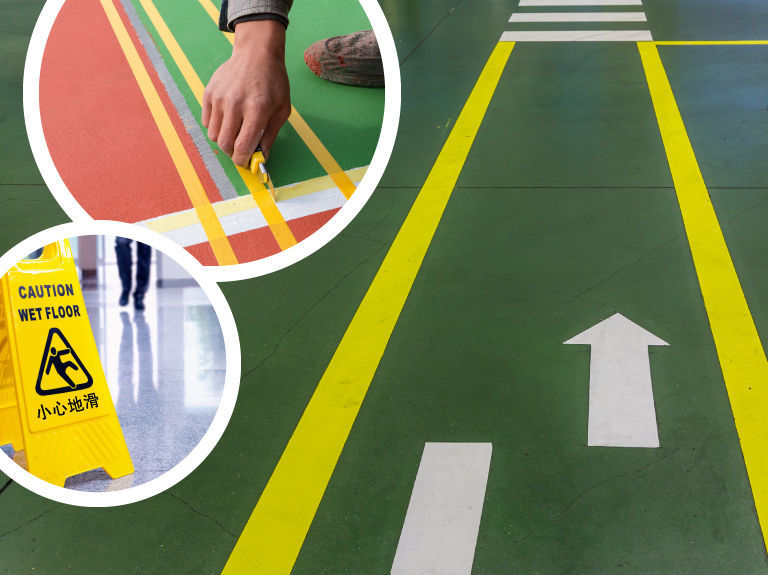
Floor tape marks aisles, pedestrian walkways, pallet storage, rack footprints, and keep-clear zones around electrical panels and fire equipment. Floor signs add information that a line cannot carry: forklift crossings, eyewash station locations, PPE requirements, and fixed homes for mobile equipment like pallet jacks and trash bins. OSHA requires permanent aisles and passageways to be marked where mechanical handling equipment is used (1910.176(a)) and requires a safe means of access and egress to every work area (1910.22(c)). OSHA 1910.144 assigns only two safety colors, red for fire protection and danger and yellow for caution; most facilities extend that with a documented color standard for the rest of the floor, drawing on the ANSI Z535 safety color conventions.
Labeling and signage
Labels carry the Safety step beyond the floor. Pipe marking labels that follow ANSI/ASME A13.1 tell workers what is in a line and which direction it flows. Rack labels, bin labels, and chemical container labels make Set in Order enforceable, which is where most of the safety benefit of 5S actually comes from: items that have a labeled home get put back, and items that get put back are not left where someone trips over them. Safety signs built to ANSI Z535 give hazard warnings a consistent signal word, color, and layout. An industrial label printer such as the LabelTac 4 lets a facility produce all of this on site as the program changes.
Physical safeguards and PPE
Visual controls do not replace guarding, lockout/tagout (1910.147), or personal protective equipment (1910.132). The Safety step documents which physical controls and PPE apply to each area and makes them part of the area standard, so a missing guard or an empty PPE station shows up on the audit. Stock the basic safety supplies each area needs where they will be used, with a labeled location, so restocking is visible.
3. Verify the controls on a schedule
Add safety criteria to the same audit used for the other five steps. Typical items: hazards identified in the last review are controlled, floor markings are intact and unobstructed, PPE stations are stocked, guards are in place, egress is clear, and no new hazards have appeared since the last audit. Score it, post the results where the team sees them, and review trends monthly. Our free 5S Scorecard can be adapted for 6S by adding a Safety section, or download the printable 5S Audit Scorecard as a starting point.
6S audit checklist
A short Safety section that can be added to any 5S audit form:
- Aisles, walkways, and emergency exits are marked and clear.
- Forklift and pedestrian paths are separated or marked at crossings.
- Fire extinguishers, eyewash stations, and electrical panels have marked keep-clear zones and are unobstructed.
- Pipes, chemical containers, and hazardous materials are labeled.
- Required PPE is posted for the area and stations are stocked.
- Machine guards are in place and lockout points are labeled.
- Damaged tools, cords, ladders, or racking have been removed or tagged out.
- Hazards found in the previous audit have been corrected.
Frequently asked questions about 6S
What does 6S stand for?
Sort, Set in Order, Shine, Standardize, Sustain, and Safety. The first five come from the Japanese terms Seiri, Seiton, Seiso, Seiketsu, and Shitsuke.
Is 6S better than 5S?
Neither is better in the abstract. 6S is a better fit for facilities with meaningful physical hazards, such as warehouses, manufacturing plants, and labs, because it forces safety onto the audit. A 5S program with safety criteria written into each step achieves the same thing.
Is 6S part of lean manufacturing?
Yes. 6S is a variation of 5S, which is one of the foundational tools of lean manufacturing and the Toyota Production System.
Where do I start with 6S?
Start with the first five steps in one pilot area, then add the Safety step to that area's standard and audit before expanding. Trying to roll out all six steps facility-wide at once is the most common reason programs stall.
What is the difference between 6S and 5S+1?
They are the same idea with different names. Some organizations write 5S+1 or 5S+S to signal that safety is layered on top of a standard 5S program.
Ready to add the sixth S? Start with the 5S Scorecard to baseline your area, then build your visual controls with floor tape, floor signs, and 6S safety supplies.